




Dual Honors from the Ministry of Environment for Low-carbon Manufacturing and Eco-friendly Materials
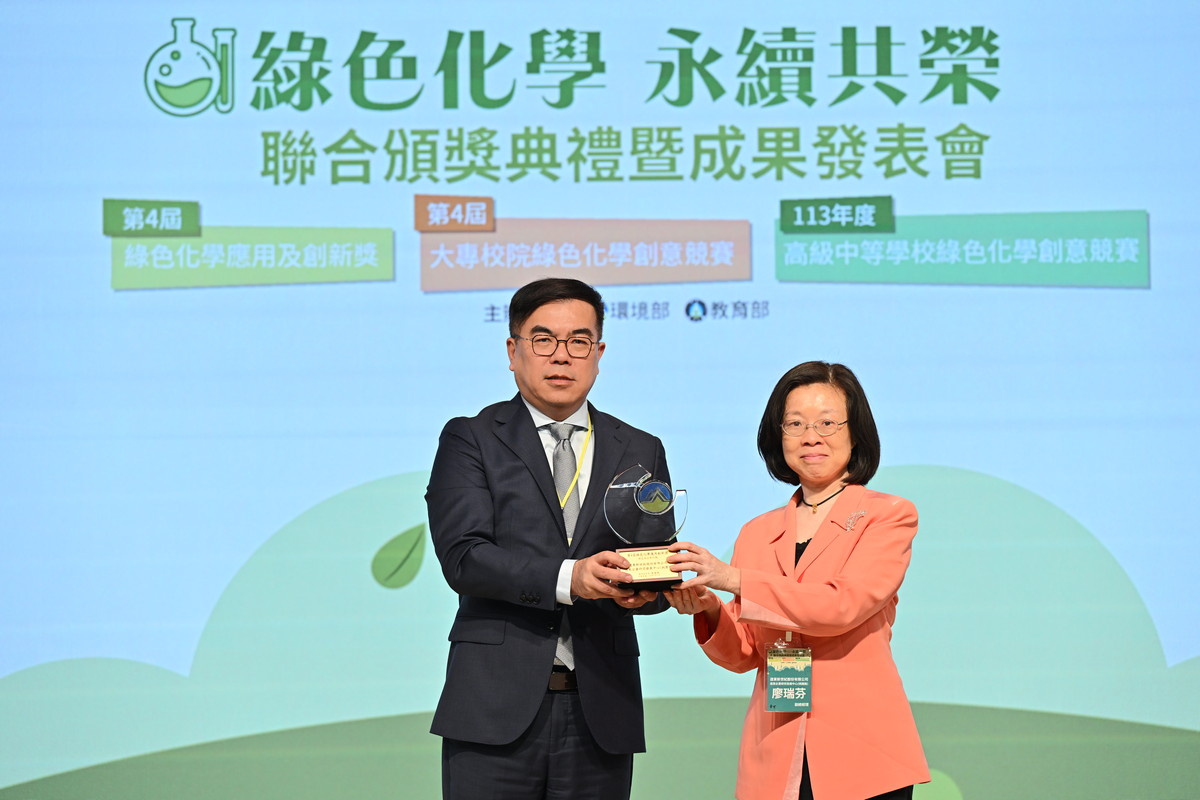
The world is at a critical juncture of net-zero transformation as industries gravitate towards breakthrough sustainable materials. Meanwhile, FENC’s decades-long devotion to the R&D of green chemistry has borne fruit, bringing innovations which received dual honors from the Ministry of Environment in the 4th Green Chemistry Application and Innovation Award and the 8th Circular Economy Excellence Awards, during which FENC won the Gold Award for the Source Management category. The acknowledgements speak to the substantial progress the Company has made in low-carbon manufacturing and the R&D of eco-friendly materials.
FENC has moved beyond the limits of conventional manufacturing with its powerful R&D momentum. The awards recognized the Company’s technological prowess, and its ability to apply chemical recycling to decompose and repolymerize polyester-containing waste into brand-new polyester products. The new products not only rival those sourced from virgin polyester in quality, but stay compatible with existing recycling systems, thus achieving resource circularity. An international partnership with LanzaTech has successfully converted carbon-containing waste gas captured from factories into monoethylene glycol (MEG), which is then processed into polyester products, creating a trailblazing blueprint for circular polyester. Another breakthrough arrived with the development of the world’s first non-isocyanate polyurethane (NIPU). Boasting carbon sequestration capabilities, NIPU is a much safer and innocuous alternative to the toxic substances contained in conventional raw materials.
Moving forward, FENC will continue to focus on recycling, decarbonization and safety with its R&D efforts and delve deeper into commercial applications of green materials. Joined by worldwide brand customers and industry partners, the Company aims to amplify its market influence for low-carbon and circular materials, creating long-lasting value for the industry on the path of sustainability transformation.