



Green Manufacturing in Action: Low-carbon Transition at FENC
FENC is profoundly aware that it takes action to reach net-zero transition, such as setting science-based targets, implementing comprehensive greenhouse gas (GHG) management and developing decarbonization collaborations with the supply chain in order to embody low-carbon practices in operations and products.
The world is entering a pivotal phase in climate governance. While the Paris Agreement greeted its 10th anniversary in 2025, the global stocktake indicated that the world is not on track to meet the goal of limiting global temperature rise under 1.5°C. Judging from discussions that took place during the 30th Conference of the Parties to the United Nations Framework Convention on Climate Change and the progress of third-generation nationally determined contributions, known as NDC 3.0, the world has considerable catching up to do in terms of the pace and magnitude of global climate action.
Meanwhile, extreme weather events triggered by climate change are growing in severity and frequency. According to the World Economic Forum’s Global Risks Report 2025, the cost per event has increased by nearly 77%, inflation-adjusted, over the last five decades. Facing increasingly critical climate risks, the business community must be proactive, responding by positioning decarbonization as a key strategy for creating long-term value.
FENC is profoundly aware that it takes action to reach net-zero transition, such as setting science-based objectives, implementing comprehensive greenhouse gas (GHG) management and developing decarbonization collaborations with the supply chain in order to embody low-carbon practices in operations and products. Following international best practices and sustainability frameworks, FENC continues increasing energy efficiency, adopting renewable energy and applying innovative technologies, working with upstream and downstream partners to keep its net-zero pathway aligned with global climate goals. Through specific measures and transparent disclosure, the Company strives to pursue tangible results through climate action, delivering sustainable value shared by all stakeholders.
Net-zero Pathway and Targets for Low-carbon Transition
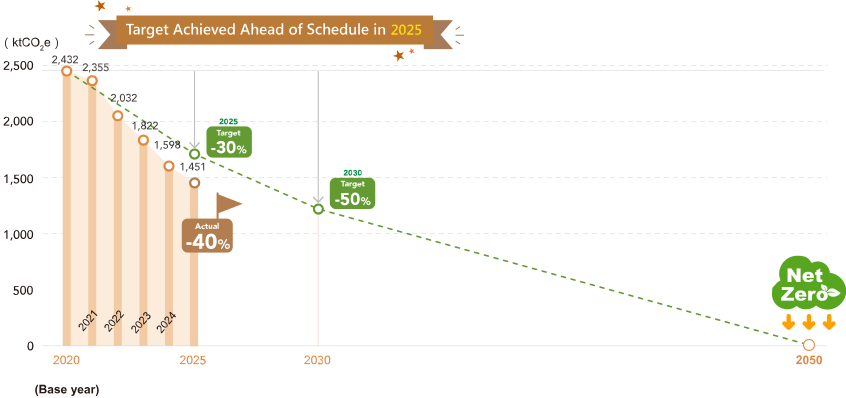
To join the global push for decarbonization and hone its competitiveness in a net-zero era, FENC has established ambitious carbon reduction targets: 30% carbon reduction by 2025 and 50% by 2030.GHG emissions were down to 1,451ktCO2e in 2025, a 40% drop from the base year.
To support the net-zero vision and inspire decarbonization throughout the industry chain, FENC has established a new set of low-carbon transition targets in 2024: reducing GHG emissions by 50%; incorporating 50% green raw materials; including 50% green products in the product mix by 2030. The Company is charting the course for a total transformation to embrace low-carbon raw materials, production and products, steering the industry to co-create a green future.
Note:
1. The disclosure of GHG emissions includes scopes 1 and 2 emissions from 100% of the production sites covered, with 2020 as the base year.
2. FENC does not use carbon offsets as the means to achieve its GHG reduction targets.
Progress of Implementing Five Major Low-carbon Transition Strategies
FENC has established five major low-carbon transition strategies, creating a green and carbon-reducing operating model through pragmatic approaches.

Improve Energy Efficiency
Progress
- FENC averted 6,537 tCO2e in GHG emissions in 2025 by improving energy efficiency through the optimization of the production process, facility and energy management.
Future Plan
- In 2030, a 30MW cogeneration system will be completed in Vietnam. The system will generate thermal energy to fuel both steam and electricity generation, which will improve fuel efficiency.
- FENC will continue to incorporate process heat recovery systems, turning high-temperature exhaust gas and waste heat into production and boiler heat sources to improve overall energy efficiency.

Adopt Low-emission Fuel Alternatives
Progress
- FEPV-Knitting and Dyeing Plant reduced carbon emissions by 22,701 tCO2e in 2025 by using biomass fuels, including wood chips and rice grains.
- The high-emission coal-water slurry and heavy oil boilers are being phased out and replaced with the natural gas boilers, a low-emission alternative, averting approximately 27,334 tCO2e of carbon emissions over the past three years.
Future Plan
- The knitting and dyeing plant of FEPV will increase the use of biomass fuels as an alternative fuel source, and the thermal substitution rate is estimated to reach 83% in 2026.
- FENC will continue to devote R&D efforts to green hydrogen and green ammonia energy applications.

Develop Renewable Energy
Progress
- As of the end of 2025, a total of 12 production sites in Taiwan, mainland China, Vietnam, and Malaysia had installed solar power generation equipment with 26,911 kW in capacity. A total of 25.87 GWh of solar power was generated for self-consumption and approximately 230 GWh of renewable electricity was purchased during the reporting year, reducing a total of 121,922 tCO2e in carbon emissions.
Future Plan
- Renewable electricity will be acquired through means such as long-term electricity purchase agreements. FENC will also continue expanding the installed capacity of renewable power generators at its worldwide locations for self-use. It is anticipated that renewable electricity consumption across FENC’s global production sites will reach 290 GWh by 2028.
Utilize CCU
Progress
- FENC pioneered the world's first waste gas recycling technology applied towards polyester production. After capturing waste gas recovered from steel mills, the microbial fermentation technology is applied to convert the waste gas to ethanol, which is then transformed into polyester products.
- FENC developed TOPGREEN® AirTek PU, utilizing groundbreaking technology to create the world’s first non-isocyanate polyurethane, which is a high-performance elastic material converted from industrially captured carbon dioxide. The production process cuts carbon emissions by up to 58% compared with the conventional polyurethane process. Additional details are provided in Instigating Production and Product Innovation.
Future Plan
- Additional applications will be developed for the waste gas recycling technology.
- FENC is establishing the Emerging Technology Carbon Reduction Team to extend the Company’s efforts in the research of information and practices in the field. Plans are underway to capture carbon dioxide directly from the emission source for conversion into usable products.

Foster Raw Material Transition
Progress
- Low-emission alternatives for raw materials, including recycled and biomass materials, have been adopted to help reduce carbon emissions in the value chain (scope 3).
- FENC, in partnership with French biochemical company Carbios, utilized the polyester enzymatic bio-recycling technology to transform complex polyester waste into purified terephthalic acid and monoethylene glycol monomers, and turned them into bio-recycled polyester fibers. This technology made its market debut in 2025 as footwear products introduced by Salomon, which were showcased at Paris Fashion Week, validating the scalability and feasibility of commercialization for the supply chain.
Future Plan
- FENC will continue to leverage core technological strengths to step up the development of new eco-friendly and low-carbon materials with expanded applications.
- Recycled raw materials: As a global leader in recycled polyester, FENC will realize its vision of strengthening the circular economy by transforming waste into valuable raw materials.
- Biomass raw materials: The R&D efforts will continue to create biomass polyester materials that can be scaled and commercialized.
Additional details are provided in Special Report 1: Waste Reduction × Green Expansion × Closed-loop Circularity: Reshaping the Sustainable Lifestyle and Green Products.
Value Chain Engagement
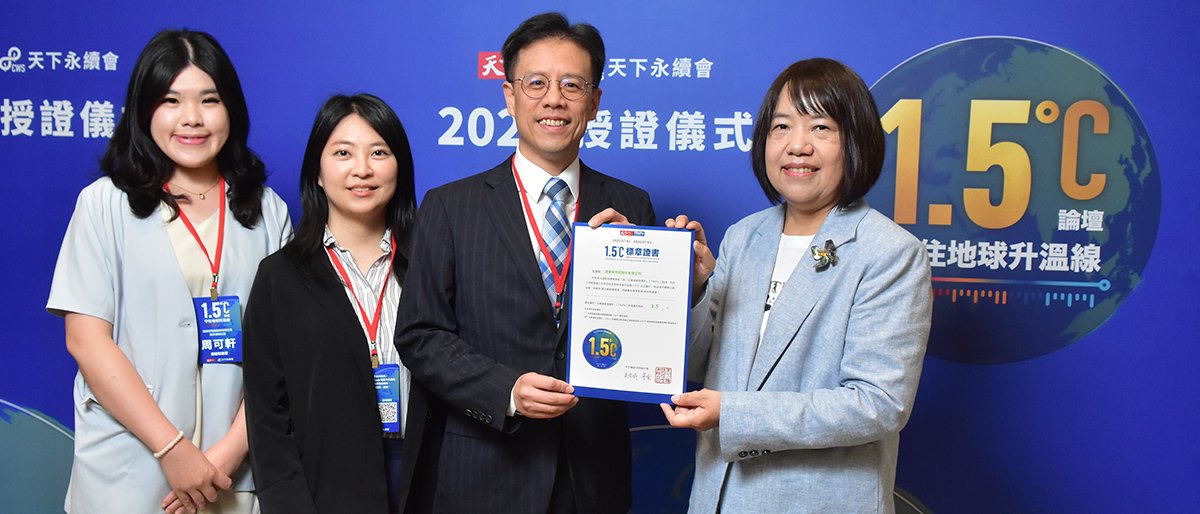
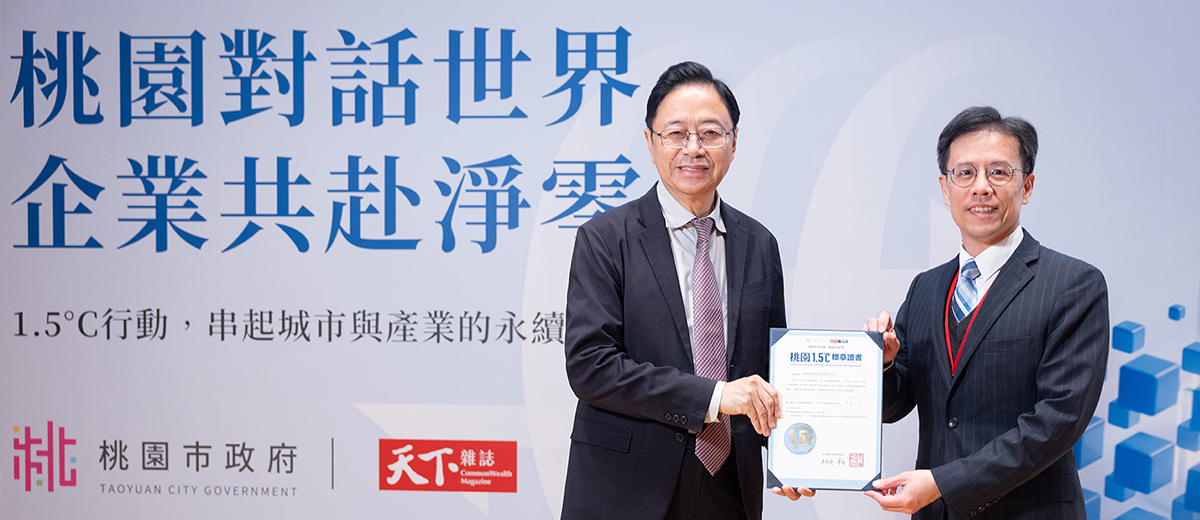
On November 18, 2025, the Taoyuan City Government and CommonWealth Magazine co-hosted a net-zero dialogue forum for the government and corporations. The event also featured a certification ceremony for demonstration enterprises to recognize the climate action taken by local businesses. Mayor Chang San-Cheng presented the 1.5°C Enterprise Certificate to FENC as a recognition for its distinguished performance in carbon reduction. Allen Sha, Executive Vice President of FENC, gave the keynote speech titled, “Sustainable Opportunities Amid Corporate Carbon Risks,” and shared FENC’s experience in promoting low-carbon transition through innovative science-based practices, which demonstrated the leadership of Taiwanese enterprises in the global march towards net zero.
In the meantime, FENC is heavily involved in the government’s engagement and implementation efforts in promoting the net-zero policy. In 2025, Ye Ri-Shen, Manager at FENC, attended as a speaker at the Net-zero Enterprise Workshop organized by the Hsinchu County Environmental Protection Bureau. During the event, he had in-depth conversations with governmental and local business representatives on the implementation of the net-zero policy. He also shared FENC’s approaches in and promotion of carbon management, energy efficiency improvement and voluntary emission reduction plans. He discussed the challenges faced by the private sector and the focus when implementing government policies, as well as feasible solutions. The intent was to enhance the connection between policy implementation and industry practice.
Through public-private dialogues such as the workshop, FENC offers not only first-hand experience to industry peers, but assistance to the government. By communicating the needs of and challenges confronted by the private sector to governmental entities, policy adjustments may be made accordingly and resources integrated appropriately. This is a successful case of public-private partnership in net-zero transition, which will boost the pace of decarbonization action.
Following the approval of carbon reduction targets submitted by the Polyester Business and FENC’s subsidiary, OTIZ, the Science Based Targets initiative (SBTi) approved the targets submitted by the Textile Business in June 2025. The short-term targets are set according to the 1.5°C pathway with the commitment to reach net zero by 2050.
In 2025, FENC once again reached the highest “Excellent” ranking in Temperature Rising Index for Pathways, an evaluation framework launched by CommonWealth Magazine and Tunghai University, and received the 1.5°C climate target label, indicating the alignment of FENC’s net-zero commitment and action with the temperature goal of the Paris Agreement, making FENC a benchmark enterprise of climate governance in the industry. FENC’s 2025 achievements also included being the inductee of Business Weekly’s Top 100 Carbon Competitiveness ranking for the second time and the winner of the Climate Leadership Award from Taiwan Corporate Sustainability Awards, demonstrating FENC’s exceptional performance in climate governance and carbon reduction.
FENC’s resolve to reduce carbon emissions is unparalleled within the industry. In 2019, FENC began implementing the Task Force on Climate-related Financial Disclosures (TCFD) to assess the impact of its business activities. The disclosures have been made public annually in the FENC Sustainability Report and its official website. On August 21, 2020, FENC signed on to become a supporter of TCFD, making the Company the first corporation in the traditional industry in Taiwan to sign and publish such a statement of support. In 2023, FENC published its first TCFD report. Each year, FENC continues aligning with the latest guidelines to refine its performance, reinforcing the transparency of disclosures regarding climate risks and financial impacts.